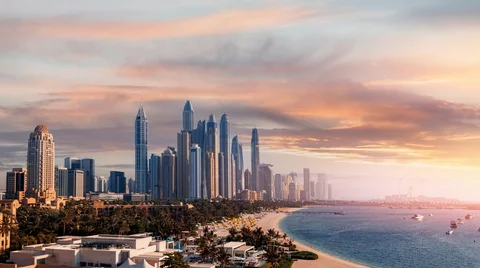
Many international buyers do not want to put down roots in the UAE - the opposite is true in Britain, which has soft power as a secret weapon.
Philip Harvey
As conflict escalates across the Gulf, it is a reminder that global wealth still values stability above all else.
Listening to a former British ambassador recently talking about the UK’s soft power was reassuring. His assertion was that our credibility on the world stage is robust and not easily diminished by momentary lapses.
Soft power, or the ability to influence others in reaching desired outcomes, has many layers. Some experts cite global perception, cultural influence, innovation and quality, as well as ethical leadership and cultural investment as key components. But I think it’s more straightforward than that.
It’s true that individuals do business with people they like, people they trust and people they find credible. However, I always point out that “like” is unfortunately the most important element. Why unfortunate? Because it is deeply subjective and can contain some distinctly irrational judgments. The world is littered with flawed business leaders, politicians and celebrities, many of whom seem to exhibit more soft power than they should.
There is a strange chemistry that draws us to them. However, when there is a lack of depth and substance, any misstep that reveals the truth can bring about a swift downfall.
Gerald Ratner’s business failed not because his jewellery was (in his words) “total crap” — it actually filled a much-needed spot in the market. The business failed because we suddenly realised that we didn’t like him, or his ego.
Conversely, people do like Apple, Virgin, Volvo and Emirates Airlines. Not necessarily because they have better products or services. We like them because the mere mention of their names creates a sense of reassurance or aspiration. They evoke trust at a very basic emotional level. They are brands that people instinctively feel comfortable with.
Countries, in many ways, operate in the same way.
As conflict flares in the Gulf, hard power is once again coming to the fore and the veil that had masked deeper regional rivalries has been lifted. For many years that veil helped create the impression that the region could represent a kind of economic nirvana — a land of milk and honey where wealth generated in mature economies could be parked in tax-friendly jurisdictions and invested in real estate with a seemingly one-way trajectory on values.
The flaw in that theory is becoming clearer. The Gulf states have struggled to generate the sort of soft power that creates deep, long-term emotional attachment.
Yes, trillions of dirhams have been spent creating remarkable environments in the sun, producing a spectacular playground for the global elite. But there remains little widespread desire for permanent roots. For most international buyers these are not places where families imagine raising several generations, building enduring communities or retiring for life.
The solid foundation of a stable property market is permanence, not speculation. Properties owned by people committed to an area for the long term, people who want to raise children and grandchildren there and feel part of a community. These buyers purchase primarily for lifestyle rather than purely financial return.
Dubai’s foundations are, quite literally, built on shifting sand. As the old saying goes, if something looks too good to be true, it probably is.
For the UK and a handful of similar locations around the world, this may ultimately prove good news. Soft power is essentially an impression of a person, business or country, often frozen in time. Great Britain remains, in the global imagination, a green and pleasant land filled with culture, history and world-class education. It is what children around the world are taught at school, what they see portrayed in films and literature, and largely what they experience when they visit.
Aside from the situation in the Gulf, we are currently witnessing a broader period of global wealth. Governments around the world are competing to attract internationally mobile individuals with tax incentives and residency programmes, while others are pushing wealth away through higher taxation and regulatory pressure.
Many of the psychological barriers that once prevented people from relocating internationally are rapidly disappearing. As is often the case, younger generations have led the way.
Governments and tax regimes will come and go. But the soft power of a country will continue to play a crucial role in determining where people ultimately choose to put down roots.
Real estate in the UK is undoubtedly going through a challenging period at present. Yet history suggests that the current price correction will eventually be viewed as just another temporary cycle.
The UK’s soft power remains an unspoken secret weapon. And as long as that remains intact, global demand for our limited supply of truly exceptional homes will endure.
Link to article: https://www.thetimes.com
You may also like…

My house renovation showed me there's little reward for going green

'Budgets start at £10k a month' - inside the Premier League's housing market
